blood cells

Bone Marrow Cells Reveal Secret Weapon to Battle Bacteria

Research Could Lead to Cell-Based Therapies for Infections and Autoimmune Reactions

bacterial colonies growing in a petri dish

One thing many scientists love about their job is that the topic they study can still surprise them even after decades of research. IRP senior investigator Eva Mezey, M.D., Ph.D., for instance, has spent the last 20 years investigating a particular set of cells in the bone marrow, yet until now she had never uncovered one of their most intriguing tricks. In a recent study, her IRP team and its collaborators discovered that those cells make a substance that can fight infections and tame hyper-active immune responses.

The Boon of Blood

A Look Inside NIH’s Department of Transfusion Medicine

a patient receiving blood during a surgery

The essential role of blood in our bodies has been recognized as far back as the time of ancient Greece, when the Greek physician Hippocrates included it in his list of four ‘humors’ that influence our health and emotions. Since then, scientists have vastly expanded our understanding of the dark red liquid running through our veins and arteries. Nowadays, researchers and technicians like those in NIH’s Department of Transfusion Medicine (DTM) can not only safely remove blood from one person and transfuse it into another, but they can also transform it into incredible forms of therapy.

IRP’s Cynthia Dunbar Elected to National Academy of Medicine

Studies of Blood Stem Cells Stimulate Pioneering Therapeutic Approaches

Dr. Cynthia Dunbar

The National Academy of Medicine (NAM), first established in 1970 by the National Academy of Sciences as the Institute of Medicine (IOM), is comprised of more than 2,000 elected members from around the world who provide scientific and policy guidance on important matters relating to human health. Election to the NAM is considered one of the highest honors in the fields of health and medicine and recognizes individuals who have not only made critical scientific discoveries but have also demonstrated a laudable commitment to public service.

IRP Distinguished Investigator Cynthia E. Dunbar, M.D., was elected to the NAM last year for her pioneering research into hematopoietic stem cells, the cells in bone marrow that develop into oxygen-carrying red blood cells, infection-fighting white blood cells, and clot-forming platelets. Her work has led to valuable insights into the production of those blood cells, called hematopoiesis, and its role in human health. Her discoveries have also resulted in new approaches to treat disease by improving stem cell functioning or manipulating stem cells with gene therapy.

Innovation Awards Spark New Intramural Collaborations

Program Boosts Initiatives Supporting Researchers Across NIH

scientists talking in a lab

From Superbowl-winning football teams to comic book cohorts like The Avengers, combining the efforts of multiple talented individuals is a proven strategy for achieving remarkable results. It may come as no surprise, then, that the NIH’s Intramural Research Program (IRP) strongly encourages collaborations that breach the boundaries of its 24 Institutes and Centers. One example of these efforts is the Director’s Challenge Innovation Awards Program, which since 2009 has funded high-impact scientific projects that bring together researchers from across the IRP.

Inflammation Cuts Lifeline for Blood-Producing Stem Cells

Discovery Could Lead to New Approaches for Boosting Blood Cell Counts

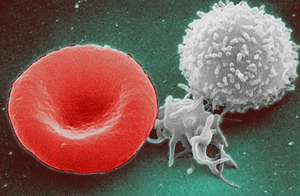
red blood cell (left), platelet (middle), and white blood cell (right)

Much of human biology is a black box — scientists know the key players and the end results, but not how those outcomes come about. Consequently, it remains a mystery why some medications help patients. A new IRP study has cracked open the black box to reveal how high levels of an inflammatory molecule inhibit blood cell production in some individuals and why a particular medicine helps reverse this life-threatening condition.

Find and Replace: DNA Editing Tool Shows Gene Therapy Promise

This image represents an infection-fighting cell called a neutrophil. In this artist’s rendering, the DNA of a cell is being “edited” with a pen-like tool to help restore its ability to fight bacterial invaders.

For gene therapy research, the perennial challenge has been devising a reliable way to insert safely a working copy of a gene into relevant cells that can take over for a faulty one. But with the recent discovery of powerful gene editing tools, the landscape of opportunity is starting to change. Instead of threading the needle through the cell membrane with a bulky gene, researchers are starting to design ways to apply these tools in the nucleus—to edit out the disease-causing error in a gene and allow it to work correctly.