
fibrosis

Startling Snapshots of Science

Vibrant Images Push Forward Environmental Health Research
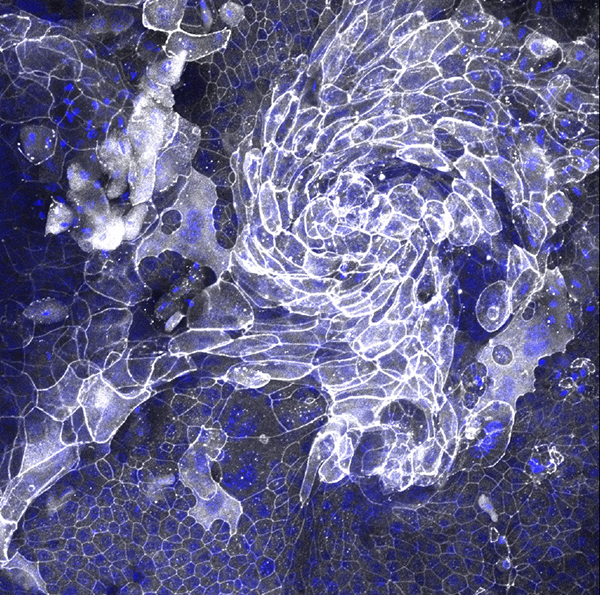
cell junctions in tracheal epithelial cells from a TLR5 knockout mouse

Scientists and artists obviously don’t spend their days doing the same thing, but that doesn’t mean the former can’t sometimes inadvertently be the latter. Take for example the 14 IRP research fellows who submitted images to the most recent edition of the Fellows Scientific Image Competition at NIH’s National Institute of Environmental Health Sciences (NIEHS). The competition, held every few years, shows that biomedical science can not only save lives, but also look good doing it.

“We are excited to showcase the work of our trainees using visual media, which reminds us there is art in science and showcases the important research we’re all engaged in at NIEHS,” says NIEHS Scientific Director Darryl Zeldin, M.D., who initiated the competition.

Saving the Skin From a Renegade Immune Reaction

IRP Study Provides Insight into Cancer Treatment’s Skin-Thickening Side Effects

person massaging his hands

Scientists have long dreamt of leveraging information about our genes to personalize medical treatment. However, in working towards that effort, they have increasingly discovered the importance not just of what genetic variants are present in a person’s DNA, but how active each of those genes is. Now, new IRP research suggests the possibility of using that information to personalize medical treatment for patients who experience serious skin problems after receiving a transplant of the bone marrow’s blood-producing stem cells.

Modified Hormone Protects Damaged Hearts

Alteration Helps Prospective Drug Persist Longer in Rodents’ Bodies

transparent view of the body with heart highlighted

Even the best construction crew cannot repair a building if it is called away from the site before it can begin its work. Similarly, while the body’s ability to cleanse itself of chemicals can prevent the buildup of toxins, it can also stymie the therapeutic effects of medications. IRP researchers recently found that modifying a prospective treatment for heart failure to help it persist longer in the body boosted its beneficial effects in mice.

Postbac Life: A Week in an IRP Lab

postbac IRTA Lindsey Jay examining a slide using a microscope

What does a postbac actually do in the NIH IRP? Maybe you have an image of someone mixing colorful chemicals together like a mad scientist (which sometimes isn’t too far from the truth).

Although I am not creating any diabolical concoctions, I am kept quite busy running tests to examine whether our treatments reverse the effects of lung fibrosis, a thickening and scarring of lung tissue. Here’s what a typical week looks like for me.

Postbac Life: Wading Into Drug Discovery Research

“That machine? You’re gonna have to get up close and personal with it,” Josh, my fellow postbac, told me. I looked at this small metal contraption and nodded, trying to appear as if I understood, while thinking: he just means that people spend so much time sectioning organs on the microtome that it’s like spending an extended amount of time with a loved one, right?

Fast forward a few days, and I find myself breathing warm, moist air onto a paraffin-embedded mouse lung to soften the wax, just before I slice four-micrometer sections of mouse lung tissue that will later be stained and examined under a microscope. “He wasn’t kidding,” I muttered.

Life of a Postbac: My Experience Joining the NIH Family

Lindsey Jay working in her lab

It was picture day, and I sat stiffly in front of a wrinkly blue curtain, nervously patting my hair into place. “You can smile, but just make sure no teeth are showing,” the person taking my picture told me. I laughed at that, and she also laughed, adding, “Everyone gets a good chuckle out of that one,” as she snapped my photo. A few days later, I picked up my photo, printed (not so) nicely with a vertical stripe running down my face. I didn’t even notice. I thought, this is real, as I proudly held up my official NIH ID badge.

Six Paths Forward in Biomedical Research

NIH Clinical Center

Last month I moderated our annual retreat with the NIH Scientific Directors, those individuals tasked with leading their Institute or Center (IC)-based intramural research program. We were joined by many of the IC Clinical Directors. And this year we decided to do something a little different: listen to a series of talks about exciting, new IRP research.