
aplastic anemia

IRP’s Cynthia Dunbar Elected to National Academy of Medicine

Studies of Blood Stem Cells Stimulate Pioneering Therapeutic Approaches

Dr. Cynthia Dunbar

The National Academy of Medicine (NAM), first established in 1970 by the National Academy of Sciences as the Institute of Medicine (IOM), is comprised of more than 2,000 elected members from around the world who provide scientific and policy guidance on important matters relating to human health. Election to the NAM is considered one of the highest honors in the fields of health and medicine and recognizes individuals who have not only made critical scientific discoveries but have also demonstrated a laudable commitment to public service.

IRP Distinguished Investigator Cynthia E. Dunbar, M.D., was elected to the NAM last year for her pioneering research into hematopoietic stem cells, the cells in bone marrow that develop into oxygen-carrying red blood cells, infection-fighting white blood cells, and clot-forming platelets. Her work has led to valuable insights into the production of those blood cells, called hematopoiesis, and its role in human health. Her discoveries have also resulted in new approaches to treat disease by improving stem cell functioning or manipulating stem cells with gene therapy.
Inflammation Cuts Lifeline for Blood-Producing Stem Cells

Discovery Could Lead to New Approaches for Boosting Blood Cell Counts

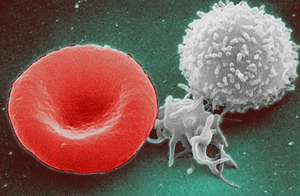
red blood cell (left), platelet (middle), and white blood cell (right)

Much of human biology is a black box — scientists know the key players and the end results, but not how those outcomes come about. Consequently, it remains a mystery why some medications help patients. A new IRP study has cracked open the black box to reveal how high levels of an inflammatory molecule inhibit blood cell production in some individuals and why a particular medicine helps reverse this life-threatening condition.

Teen Travels from Jamaica to the NIH for Aplastic Anemia Treatment

Sixteen-year-old Howayne and his Aunt Michelle

Sixteen-year old Howayne McGregor, from Jamaica, suddenly collapsed on his routine walk to school and was rushed to the nearest hospital. After sending his lab results to Dr. Neal Young at the National Institutes of Health (NIH), Howayne received the diagnosis of aplastic anemia, a rare but serious blood disorder in which the body’s bone marrow doesn’t make enough new blood cells.

How Asking a Very Basic Research Question Led Us to a Model For At Least 3 Diseases

When I started this project, it was not my objective to develop a model for any specific disease, nor did I even suspect that the ultimate result would be some insight into autoimmune disease. The basic research question I was asking was why there are sequences in the 3’ untranslated region of the interferon-gamma mRNA that are more highly conserved than the coding region of the gene.

ARE region