
motor neurons

IRP Scientist Shares Path From Stuttering to Science

Diversity-Focused NIH Program Helps Dr. Shahriar SheikhBahaei Investigate the Neuroscience of Voluntary Movement
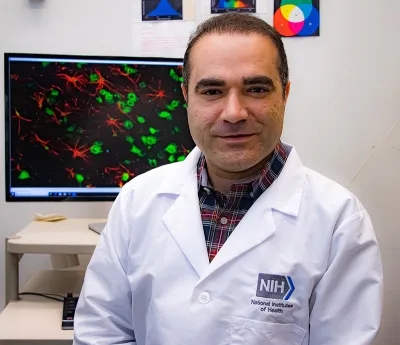
Dr. Shahriar SheikhBahaei

IRP neuroscientist Shahriar SheikhBahaei, Ph.D., first became aware of his stutter when he was 5 years old. Years later, his career would revolve around studying the biological roots of his speech impediment. But before he could start his own lab focused on how the brain controls voluntary movement, he needed a leg up from NIH’s Independent Research Scholars (IRS) program.

IRP’s Richard Youle Receives Breakthrough Prize

‘Silicon Valley Nobel’ Recognizes Groundbreaking Parkinson’s Disease Research

Dr. Richard Youle

It can be easy to underestimate the value of so-called ‘basic science’ that doesn’t appear, upon first glance, to have clear therapeutic applications. One of the hidden strengths of this sort of work is its ability to link seemingly disparate areas of scientific inquiry by identifying commonalities between the structure or behavior of different biological molecules. By following these unexpected connections over the course of his career, IRP senior investigator Richard Youle, Ph.D., has made critical discoveries about Parkinson’s disease — research that this year earned him the prestigious Breakthrough Prize in Life Sciences.

Summertime Brains: Joanne Compo

Joanne Compo, a sophomore at the University of Washington in Seattle, Washington, spent the summer of 2017 working in the lab of NIH IRP Distinguished Investigator Dr. Kenneth Fischbeck. She helped create a quality of life questionnaire for patients with Kennedy’s disease, a neuromuscular disorder that causes muscles to weaken over time due to the death of motor neurons responsible for movement. Such a questionnaire could help affected individuals get diagnosed more quickly and shed light on which interventions improve their lives the most.