in memoriam

NIH Remembers Research Pioneer Gary Felsenfeld

Dr. Gary Felsenfeld

“To focus on an experiment and to shut out everything else is one of the great pleasures,” said NIH distinguished investigator Dr. Gary Felsenfeld in his 2020 oral history. 

During his more than 60 years at the National Institute of Diabetes and Digestive and Kidney Diseases (NIDDK), Felsenfeld’s keen focus and enthusiasm for science never flagged. His long career was marked by monumental, lasting breakthroughs that transformed the field of molecular biology, particularly in relation to chromatin — the complex mixture of DNA and proteins that form chromosomes inside the nucleus of a cell.

Felsenfeld died on May 1 at age 94.

NIH Mourns the Passing of Dilys Parry

Dr. Dilys Parry

Dr. Dilys Parry died peacefully in her sleep in the early morning of February 2, 2024, after a long illness. For 30 years, Dr. Parry was a staff clinician and principal investigator in the Division of Cancer Epidemiology and Genetics (DCEG) at NIH's National Cancer Institute (NCI). Following her retirement from federal service in 2007 she continued to engage with her colleagues on projects as a special volunteer. 

Dr. Parry’s medical genetics research focused primarily on genetic and clinical studies of neurofibromatosis 2 (NF2) and chordoma, a rare bone tumor derived from the notochord, and adult brain tumors. She was deeply committed to educating patients about the natural history of these diseases and helping them and at-risk relatives receive genetic testing or other types of screening to aid in early detection and treatment. Her research helped to identify susceptibility genes for and delineate the spectrum of clinical manifestations associated with NF2 and chordoma. She also elucidated correlations between the specific types of variants in the gene NF2 and clinical findings. Much of the momentum that exists in chordoma research traces back to Dr. Parry’s early interest in the disease.

NIH Mourns the Passing of S. Perwez Hussain

Dr. S. Perwez Hussain

The IRP community is profoundly saddened by the passing of S. Perwez Hussain, Ph.D., Senior Investigator in the Laboratory of Human Carcinogenesis at the National Cancer Institute (NCI). He died on November 24, 2023, after living with stage 4 colon cancer for many years.

For over 25 years, Perwez led translational research that could be brought into clinical trials for patients with pancreatic cancer and he established the pancreatic cancer research program in the Laboratory of Human Carcinogenesis. He was known as an exceptional scientist, caring mentor, kind colleague and friend to many.

NIH Mourns the Passing of W. Michael Kuehl

Dr. W. Michael Kuehl

The IRP community mourns the recent passing of our colleague W. Michael Kuehl, M.D., former senior investigator in the Genetics Branch at the National Cancer Institute (NCI), after a long struggle with renal cancer.

In his more than 30 years at NCI, Michael was devoted to understanding the cellular and molecular biology of multiple myeloma (MM) and pre-malignant MGUS (monoclonal gammopathy of uncertain significance), a precursor of the disease. He identified multiple mechanisms of molecular pathogenesis in MM and he linked pre-malignant MGUS to MM, which is relevant for the early diagnosis and treatment of MM.

NIH Mourns the Passing of Dr. Herbert M. Geller

Dr. Herb Geller

The IRP community is saddened by the recent passing of our esteemed colleague, Herb Geller, Ph.D., who died April 16, 2023, at the NIH Clinical Center from complications of advanced prostate cancer. He is survived by his wife of 55 years, Nancy Geller, Ph.D., who is the Director of the Office of Biostatistics Research at the National Heart, Lung, and Blood Institute (NHLBI).

Dr. Geller joined the National Institutes of Health in 2001, where he became the Chief of the Developmental Neurobiology Laboratory in the Cell and Developmental Biology Center at NHLBI. During his long and successful career in neurobiology, Dr. Geller made a significant impact on the field of neuroscience. His laboratory focuses on understanding the role of the extracellular matrix — the intricate network of molecules that surround cells which control migration, pathfinding, and growth of neurons during brain development.

NIH Mourns Two Accomplished Cancer Researchers

A Tribute to Drs. James M. Phang and John J. DiGiovanna

Dr. John J. DiGiovanna (left) and Dr. James M. Phang (right)

The IRP is deeply saddened by the recent passing of two members of its community, James "Jim" M. Phang, M.D., and John J. DiGiovanna, M.D. Dr. Phang passed away on January 29 after a months-long struggle with esophageal cancer. Dr. DiGiovanna died on February 6, more than two years after his diagnosis of metastatic pancreatic cancer.

NIH Mourns the Passing of Ji Ming Wang

Dr. Ji Ming Wang

The IRP community is profoundly saddened by the recent passing of Ji Ming Wang, M.D., Ph.D., Senior Investigator and Head of the Chemoattractant Receptor and Signal Section in the Cancer Innovation Laboratory at NIH's National Cancer Institute (NCI). He died unexpectedly on December 24, 2022.

Dr. Wang studied the role of chemoattractant receptors in infection, inflammation, immune responses and cancer progression for over 30 years. In 1998, Ji Ming was the first to identify a critical role for the receptors in mediating cancer cell metastasis to distant organs. His later work focused on leukocyte infiltration, a hallmark of inflammation and cancer progression.

NIH Mourns the Passing of Joost J. Oppenheim

Joost J. Oppenheim, M.D.

The IRP community is profoundly saddened by the recent passing of Joost “Joe” Oppenheim, M.D., Senior Investigator and Head of the Cellular Immunology Section in the Cancer Innovation Laboratory at NIH‘s National Cancer Institute (NCI). He died on May 14, 2022, at the age of 87.

Dr. Oppenheim was engaged in cellular immunology research at NIH for five decades and was instrumental in the discovery of cytokines, chemokines, and alarmins, which are substances produced by immune cells that enable them to communicate and act as ‘first responders” to injury or infection.

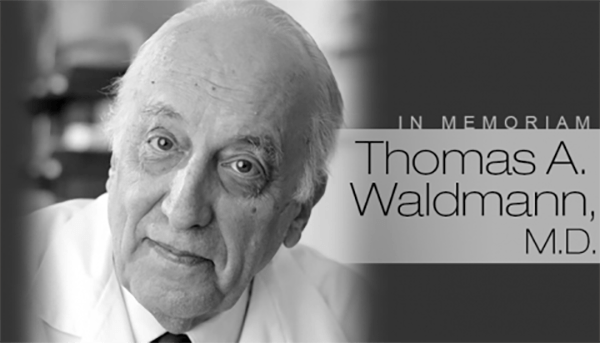
NIH Mourns the Passing of Thomas A. Waldmann

Dr. Thomas A. Waldmann

The NIH community is profoundly saddened by the recent passing of Thomas A. Waldmann, M.D., Chief Emeritus of the Lymphoid Malignancies Branch and NIH Distinguished Investigator.

Considered a giant in the field, Tom was a renowned immunologist whose more than 60-year career at the National Cancer Institute led to numerous high-impact discoveries that advanced the fields of organ transplantation, autoimmune disease and cancer. He was a leader in the study of cytokines and their receptors and of monoclonal antibodies, now a dominant form of cancer immunotherapy.

NIH Mourns the Passing of George Patterson

Dr. George Harold Patterson

George Harold Patterson, a senior investigator and chief of the Section on Biophotonics at NIH’s National Institute of Biomedical Imaging and Bioengineering (NIBIB), died of complications from pancreatic cancer on June 20, 2021. He was only 50 years old, recently tenured, with a wife, two small children, and a promising career before him. We are just so sad about the loss of this warm friend and brilliant and creative scientist taken away far too soon.

George's research focused on the development of probes and techniques for diffraction-limited and sub-diffraction-limited fluorescence imaging of cells and tissues. Indeed, as a staff scientist in the NIH lab of Jennifer Lippincott-Schwartz, George worked intimately with Eric Betzig in the development of the nanometer-level resolution techniques that earned Eric a Nobel Prize in 2014.