training

Summertime Brains: Alex Fuksenko

Alex Fuksenko, a senior at the University of Maryland in College Park, spent his summer in the lab of NIH IRP Investigator Kevin Briggman, Ph.D.

Fuksenko helped to create a website called Labrainth that “gamifies” the identification and tracing of neurons in 2D images produced by electron microscopes. By visiting the website and completing those activities, members of the public can earn points and move up leaderboards while producing data that machine learning algorithms can use to learn how to trace neurons in these images themselves, a necessary step towards producing an accurate 3D model of the human brain.

New Study Categorizes Biomedical Careers

After postdoctoral fellows in biomedical research complete their training, they are prepared to land permanent positions that utilize their unique research skills. While some may choose the traditional academic route, and become tenure-track scientists, many take posts that keep them engaged in science, but not necessarily doing research.

For the first time at the NIH’s National Institute of Environmental Health Sciences (NIEHS), these non-faculty jobs, and the numbers of NIEHS postdocs in them, are broken down in a study that appeared online in the January 15 issue of Nature Biotechnology. The paper discussed a new tool that visualized the kinds of work the former postdocs were doing.

graphs showing career outcomes for NIEHS postdocs

Summertime Brains: Carly Kaplan

Carly Kaplan, a junior at Brown University in Providence, Rhode Island, spent her summer working in the lab of NIH IRP Investigator Dr. Kareem Zaghloul. As a member of Dr. Zaghloul’s team, Carly examined how the human brain creates and recalls memories. An aspiring doctor, she believes that this sort of research is “the backbone of the medical profession” and that “doctors can’t do what they do without the research behind it.” While at NIH, she was particularly intrigued by the opportunity to watch Dr. Zaghloul perform neurosurgery on the epilepsy patients who were part of in his lab’s studies.

Summertime Brains: Joanne Compo

Joanne Compo, a sophomore at the University of Washington in Seattle, Washington, spent the summer of 2017 working in the lab of NIH IRP Distinguished Investigator Dr. Kenneth Fischbeck. She helped create a quality of life questionnaire for patients with Kennedy’s disease, a neuromuscular disorder that causes muscles to weaken over time due to the death of motor neurons responsible for movement. Such a questionnaire could help affected individuals get diagnosed more quickly and shed light on which interventions improve their lives the most.

Summertime Brains: Francia Fang

Francia Fang, who is currently a junior at Duke University, spent her 2017 summer working in the lab of NIH IRP Senior Investigator Dr. Zhengping Zhuang. During her time at the NIH, Fang investigated how genes influence the development of brain tumors and also shadowed doctors as they met with brain cancer patients.

The video above, featuring Fang, is the first in a series of profiles highlighting IRP summer interns who worked in NIH National Institute of Neurological Disorders and Stroke (NINDS) intramural labs this past summer.

NIH Graduate Partnerships Equal Two-Times the Science

Simona

For many young researchers, spring is the time to make a decision of how to continue with their education and perhaps whether partnering with a lab in the NIH IRP for their dissertation research might be the right path for them. What is it like to be a graduate student at two institutions?

Inspirations in Science and Medicine

You never know when inspiration will strike. I still remember the day that Dr. Francis Collins came to visit my high school genetics class. At that time, Dr. Collins was the director of the Human Genome Project, an international research program aimed at uncovering the genetic building blocks essential for human life. Imagine our recent excitement when Dr. Collins, now Director of the NIH, specially attended a reception for clinical fellows at the Clinical Center.

NIH Clinical Fellows Gathering, Collins, Gallin

A Graduate Student’s Journey in the NIH IRP

Lucy Kotlyanskaya at the lab bench

As a recently graduated student at the NIH, in partnership with University of North Carolina at Chapel Hill, I felt so privileged to be a member of this amazing community of scientists, and I want to create awareness that there are opportunities for graduate students to do research in the NIH Intramural Research Program (IRP). The NIH IRP provides training to scientists at every level of experience.

What’s in a Name, Postbac IRTA?

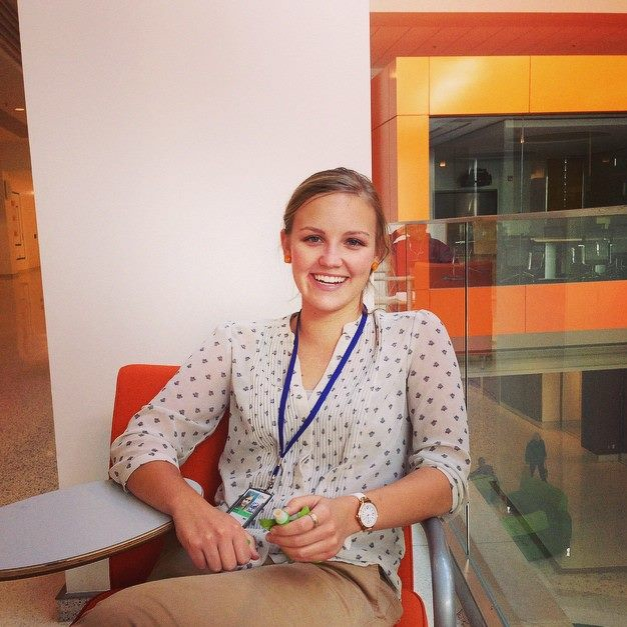
We are all given a name by our parents, nicknames by friends, roles and titles in school and at work. In my life, I have been known as “Goose,” “that blonde girl over there,” and, most commonly, “Lucy.” Here at the NIH, my most important title is that of “postbac,” or, more endearingly, “fledgling scientist.” Although this title does not necessarily command awestruck wonder, it does indicate recent graduates’ integral roles in labs at the NIH. The road to success is long, yet well worn, and we all have our own starting points.

Lucy Bauer, NCCIH