
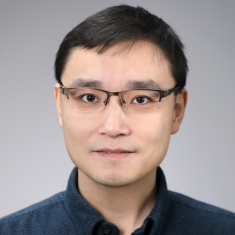
Chongyi Chen, Ph.D.
Stadtman Investigator
Laboratory of Biochemistry and Molecular Biology
NCI/CCR
Research Topics
DNA topology (aka DNA supercoiling) is an intrinsic physical property of the double helix that reflects its underwound or overwound state (COSB 2024). Although it is a fundamental feature of chromatin, its role in genome regulation and function has been difficult to study because measuring DNA supercoiling in living cells independently of other chromatin features remains challenging.
To address this gap, we developed ATMP-seq, a quantitative genome-wide assay for DNA supercoiling (NSMB 2025). ATMP-seq enabled direct visualization of both negative and positive twin-supercoiled domains around genes. It also revealed that DNA supercoiling is widespread across the human genome, rather than confined to gene-proximal regions. This work provided a framework for investigating the topological genome (NSMB 2025). We further found that transcription elongation is the primary source of genome-wide DNA supercoiling. During RNAP elongation, human topoisomerases preferentially relax positive supercoils, generating excessive negative supercoiling that drives large-scale supercoiling across the genome (bioRxiv 2026).
DNA topology also actively shapes transcription. Building on my earlier work on DNA supercoiling in bacteria (Cell 2014) and my expertise in single-cell genomics (Science 2017), we developed single-cell transcriptome (Genome Biology 2023) and nascent transcriptome assays (Cell Reports Methods 2026) to investigate how DNA topology regulates human transcription. We showed that topoisomerase-mediated resolution of negative supercoiling is essential for sustained gene expression in human cells (bioRixv 2026). Disrupting topological homeostasis allows negative supercoiling to accumulate, compromising gene expression and reducing transcriptional burst size and frequency. We further found that TOP1 helps maintain chromatin looping, including enhancer-promoter interactions, under steady state conditions and supports rapid gene upregulation during T-cell activation (bioRixv 2026). As a summary, topoisomerase-mediated maintenance of DNA topological homeostasis is an essential mechanism for human transcription and gene activation.
Maintaining genome-wide topological homeostasis requires continuous topoisomerase catalysis, which generates transient topoisomerase cleavage complexes (TOPcc). We developed pDAIP-seq, a genome-wide assay that profiles endogenous TOPcc without requiring exogenous topoisomerase poisons for enrichment (bioRxiv 2026). Using pDAIP-seq, we established a regulatory framework for endogenous TOP1cc across the human genome, with its formation governed globally by the maintenance of topological homeostasis, while its regional distribution shaped by local DNA sequence context. Our results also suggest that endogenous TOP1cc may be a major source of spontaneous DNA breaks in human cells, linking DNA topological regulation to genome instability.
Our goal is to establish topological genomics as a new frontier in genome biology. By combining technology development with mechanistic studies, we aim to uncover the role of DNA topology as a fundamental genome dimension in health and disease.
Biography
Dr. Chen earned his B.S. in biology from Peking University and his Ph.D. in biochemistry from Harvard University. During his doctoral studies in the lab of X. Sunney Xie, in collaboration with Xiaowei Zhuang’s lab, he investigated chromosome organization and revealed the role of DNA supercoiling and DNA topoisomerase in transcriptional bursting in bacteria, utilizing advanced single-molecule imaging tools and the chromosome conformation capture assay. As a postdoctoral fellow at Harvard University in the Xie Lab, he was trained for genomics and single-cell technology development in biology and medicine, and developed a new single-cell whole-genome amplification assay that enables accurate detection of mutations and copy-number variations across the human genome in individual cells. He joined the Center for Cancer Research as an NIH Stadtman Investigator in October 2018.
Selected Publications
- Lyu J, Xu X, Chen C. A convenient single-cell assay for the newly synthesized transcriptome reveals FLI1 regulon downregulation during T cell activation. Cell Rep Methods. 2026;6(1):101252.
- Yao Q, Zhu L, Shi Z, Banerjee S, Chen C. Topoisomerase-modulated genome-wide DNA supercoiling domains colocalize with nuclear compartments and regulate human gene expression. Nat Struct Mol Biol. 2025;32(1):48-61.
- Li S, Vemuri C, Chen C. DNA topology: A central dynamic coordinator in chromatin regulation. Curr Opin Struct Biol. 2024;87:102868.
- Lyu J, Chen C. LAST-seq: single-cell RNA sequencing by direct amplification of single-stranded RNA without prior reverse transcription and second-strand synthesis. Genome Biol. 2023;24(1):184.
Related Scientific Focus Areas

Biomedical Engineering and Biophysics
View additional Principal Investigators in Biomedical Engineering and Biophysics

Molecular Biology and Biochemistry
View additional Principal Investigators in Molecular Biology and Biochemistry
This page was last updated on Wednesday, October 7, 2026